Understanding the role of an Internal Quality Assurer (IQA) is essential for anyone involved in assessment, training delivery or taking QA courses. IQAs — sometimes called internal verifiers — protect the fairness, validity and reliability of assessment decisions. This article explains the core responsibilities of an IQA, how QA courses prepare people for the role, and why this work matters in the UK context using current, meaningful statistics.
QA courses give learners the theory and practical tools to design sampling strategies, conduct standardisation events, monitor assessors and produce auditable records. A solid QA course makes the difference between good intentions and evidence-based quality assurance: an IQA isn’t just a checkbox — they’re the people who demonstrate to awarding organisations and regulators that assessment systems are working as intended.

At its heart, the responsibility of an IQA is to ensure assessment decisions are consistent, valid and fair. Typical day-to-day duties — all covered by quality-assurance-focused QA courses — include:
Sampling assessment decisions: planning and executing a risk-based sampling schedule to check assessor judgements across units, assessors and delivery sites.
Standardisation and moderation: running regular standardisation meetings so assessors apply assessment criteria consistently.
Observing assessment practice: conducting observations of assessment events and professional discussions to confirm evidence authenticity.
Providing developmental feedback: giving assessors actionable feedback and arranging targeted CPD to close gaps.
Record-keeping and reporting: maintaining auditable records (sampling plans, feedback forms, standardisation minutes) that show decisions and follow-up actions.
Liaison with awarding organisations and external quality assurance: responding to queries and preparing for audits or spot-checks.
These responsibilities are the practical backbone taught by QA courses that aim to prepare IQAs to operate within regulated systems.
In England, awarding organisations and centres must meet regulator standards — and that expectation filters down to centre-level IQA practice. IQAs help centres meet the conditions set by regulators by producing the evidence that assessment is fit for purpose and compliant. QA courses teach how to translate regulatory requirements into day-to-day IQA activity and documentation.
The qualifications and apprenticeships landscape in the UK is large and varied — which makes robust internal quality assurance essential:
The regulated qualifications market in England reported 16,409 qualifications available for certification in the 2023–24 academic year and 255 recognised awarding organisations, which underlines the complexity of assuring consistent assessment across providers. That scale is precisely why trained IQAs and QA courses are so important.
Apprenticeship activity remains substantial: there were 339,580 apprenticeship starts in the 2023/24 academic year, and higher-level (Level 4 and above) apprenticeships accounted for a large share of starts — placing extra emphasis on rigour in assessment and internal quality assurance. An IQA trained via appropriate QA courses helps protect the credibility of these routes.
Employers continue to report serious skills shortages: the Employer Skills Survey 2022 found 531,200 skill-shortage vacancies in the UK and a skill-shortage vacancy density of 36% — evidence that accurate, reliable assessment (and therefore responsible IQA practice through QA courses) is central to producing job-ready learners.
Good QA courses combine knowledge and application:
Translating rules into sampling, record-keeping and standardisation templates you can use tomorrow.
Templates for sampling plans, observation forms and evidence trackers.
Deepening understanding of validity, sufficiency, authenticity and reliability.
How to deliver developmental feedback and lead standardisation sessions that change practice.
Completing QA courses gives measurable capability: you’ll leave with a portfolio, practical plans and the confidence to create audit-ready evidence.
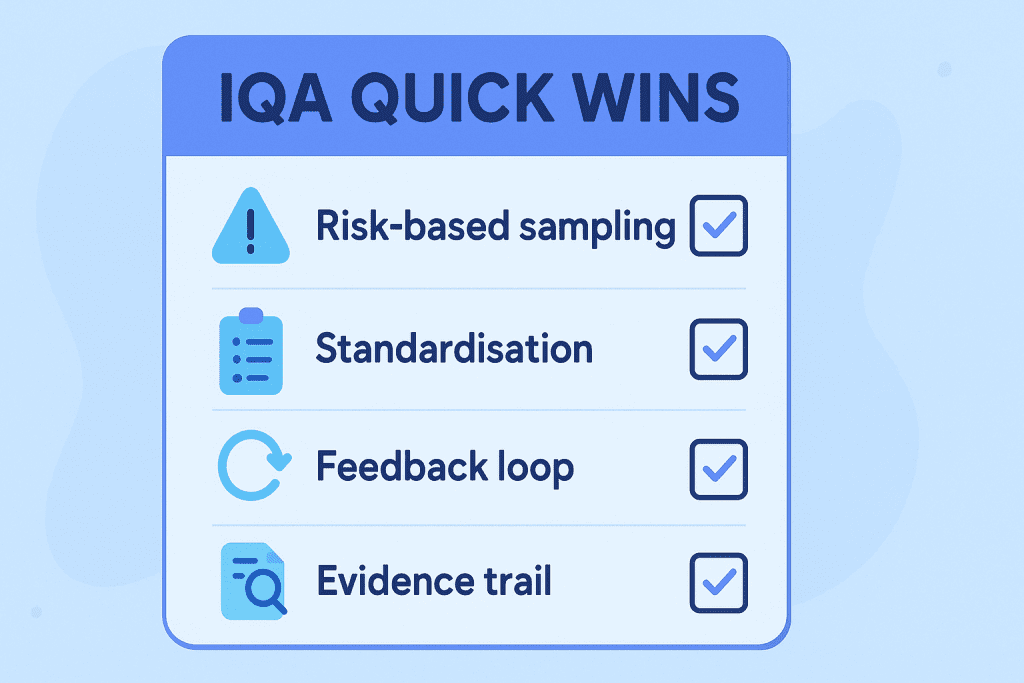
Be risk-led: focus sampling where new assessors, new units or high-stakes qualifications exist.
Keep standards visible: short, frequent standardisation beats long, infrequent meetings.
Make records useful: capture not just findings but actions, who did them and the date when you re-sampled.
Use data: link your IQA findings to achievement, attendance and employer feedback — this tells the story of impact.
The responsibility of an IQA is practical and consequential: they are the stewards of fair and reliable assessment. In a UK system with thousands of regulated qualifications and large apprenticeship volumes, the need for skilled IQAs is clear. QA courses are the fast track to that expertise — equipping you to build sampling plans, lead standardisation and produce the auditable evidence that regulators, awarding organisations and employers expect.